
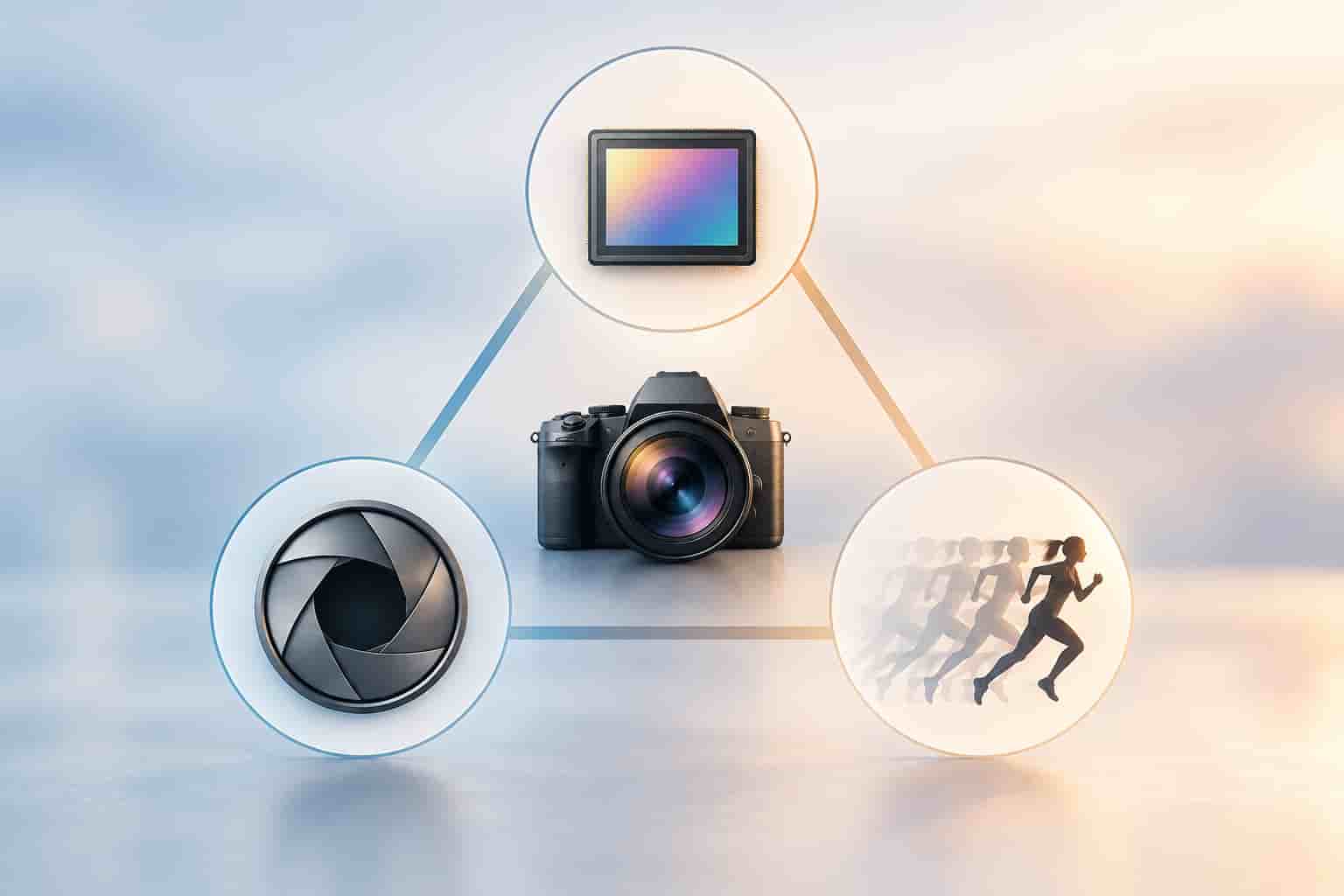
Think of exposure as how bright or dark your final photo turns out. Get it right and your image looks natural and well-lit. Get it wrong and you end up with a photo that’s too bright (overexposed) or too dark (underexposed). The good news is that exposure is controlled by just three settings — shutter speed, aperture and ISO — and understanding how they work together is one of the most useful things you can learn in photography. Together, these three are known as the exposure triangle.
The three sides of the triangle
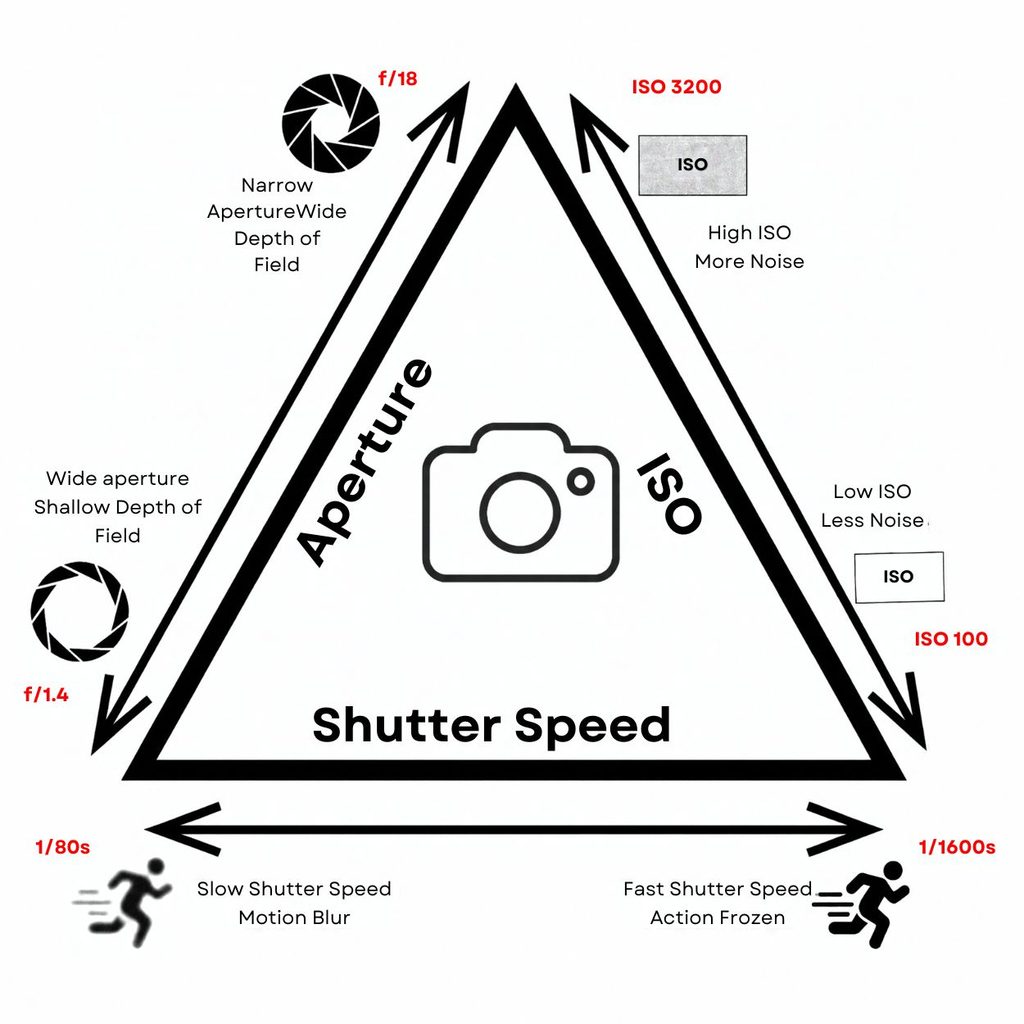
Each setting affects exposure, but each one also has a second effect on the look of your image:
- Shutter speed controls how long the sensor is exposed to light. A faster shutter speed lets in less light but freezes motion. A slower shutter speed lets in more light but can introduce motion blur.
- Aperture controls the size of the opening inside the lens that lets light through, measured in f-stops (such as f/1.8, f/5.6, f/16). A wide aperture (low f-number like f/1.8) lets in more light and blurs the background. A narrow aperture (high f-number like f/16) lets in less light and keeps more of the scene in sharp focus.
- ISO controls how sensitive the camera’s sensor is to light. A low ISO (e.g. 100 or 200) produces a clean, detailed image but needs more light. A high ISO (e.g. 3200 or 6400) works in darker conditions but can introduce digital noise — a grainy or speckled look in the image.
Why “triangle”?
Because changing one setting almost always means adjusting at least one of the others to keep the exposure balanced. They are linked. Increase the shutter speed to freeze a moving subject and the image gets darker, so you might open the aperture wider or raise the ISO to compensate. Lower the ISO for a cleaner image in bright light and the image might become overexposed, so you might use a faster shutter speed or narrow the aperture to bring the brightness back down.
How do photographers use this in real life?
- Bright outdoor portrait: A photographer might use a wide aperture (f/1.8) to blur the background and separate the subject, a fast shutter speed (1/500) to keep things sharp, and a low ISO (100) because there’s plenty of natural light available.
- Dark indoor event: With less light available, a photographer might raise the ISO (e.g. 1600 or 3200), open the aperture as wide as it goes, and drop the shutter speed to let in as much light as possible — accepting a little noise or slight blur as a trade-off.
- Landscape at golden hour: A photographer might use a narrow aperture (f/11) for a sharp foreground and background, a low ISO for a clean image, and adjust the shutter speed accordingly — possibly needing a tripod if the shutter speed drops too low.
Quick tip: When you change one setting and something looks off, ask yourself which of the other two can fix it. Most exposure problems in real shooting come down to finding the right balance between all three.
Recap: The exposure triangle is the relationship between shutter speed, aperture and ISO.
- Shutter speed = controls time = affects motion blur
- Aperture = controls lens opening = affects depth of field (background blur)
- ISO = controls sensor sensitivity = affects image noise
- Change one and you’ll likely need to adjust another — that balancing act is exposure.