

Think of aperture as the camera’s “pupil”: an opening inside the lens that widens or narrows to control how much light reaches the sensor. Aperture size is described using f-numbers (like f/1.8, f/5.6, f/16). Here’s the part that often feels backwards at first:
- Small f-number (e.g., f/1.8) = a bigger opening = more light
- Large f-number (e.g., f/16) = a smaller opening = less light
The diagram below shows how the opening changes as the f-number changes.

Aperture doesn’t just affect brightness—it also changes how much of your photo looks sharp. This is called depth of field:
Depth of field describes the range in front of and behind your focus point that appears acceptably sharp. In general:
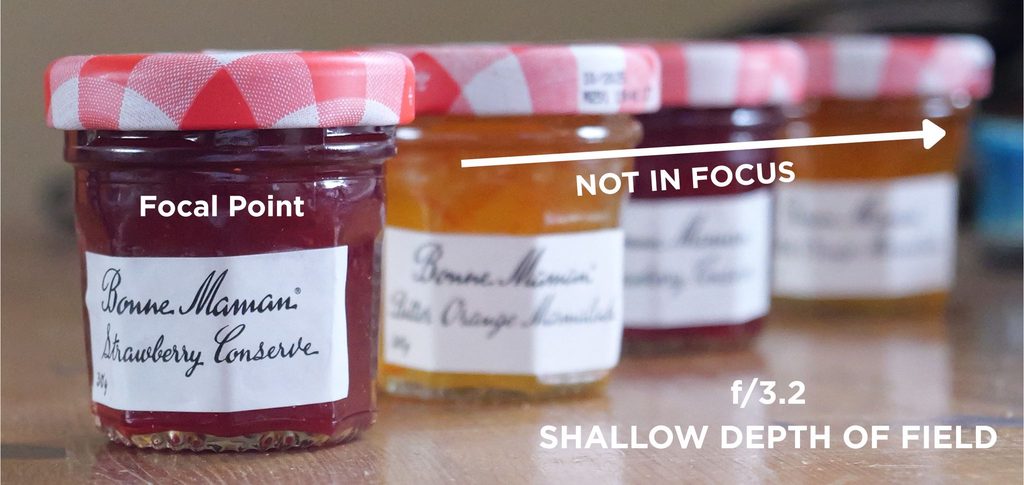
- Wide aperture (small f-number) creates a shallow depth of field, so only a thin slice of the scene is sharp and the background/foreground blur more.
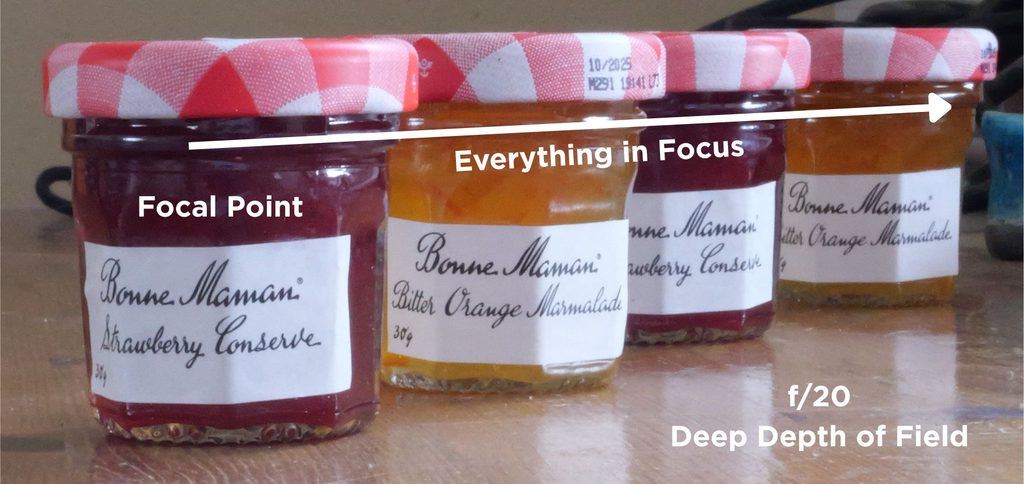
- Narrow aperture (large f-number) creates a deep depth of field, so more of the scene stays sharp from front to back.
The photos below illustrate the difference in depth of field at different aperture settings. (Other factors—like how close you are to your subject and your lens focal length—also affect depth of field, but aperture is the easiest place to start.)
So how do photographers use this in real life?
- Portraits: Portrait photographers often choose a wide aperture (for example f/1.8 to f/2.8) to keep the subject sharp while the background falls beautifully out of focus, reducing distractions.
- Landscapes: Landscape photographers usually want detail across the whole scene, so they pick a narrower aperture (often around f/8 to f/16) to maximise the amount of the image that appears sharp.
Quick tip: If you change aperture and your photo becomes too bright or too dark, compensate by adjusting shutter speed and/or ISO—aperture is part of a three-way exposure balance.
Recap: Aperture controls how much light enters the camera and how blurred or sharp the background looks.
Small f-number = bigger opening = more light and more blur
Large f-number = smaller opening = less light more of the scene in focus.
“Aperture is where light becomes a creative choice.”